Wednesday, 19 November 2014

Partition (Ken McMullen, 1987)


(written as a review and podcast for MovieMail in 2007)
_________________________

On August 14th and 15th, 1947 (two days, so that the Governor General of India could attend both ceremonies in Karachi and Delhi), the British Indian Empire was partitioned on religious grounds into a secular union of India and a Muslim Dominion of Pakistan, and the two countries became independent nations. In the mass migration that followed, with over 14 million people changing countries, terrible violence betweens Hindus, Muslims and Sikhs erupted and hundreds of thousands were killed.

Ken McMullen's powerfully provocative film, adapted by Tariq Ali from Saadat Hasan Manto's famous short story, Toba Tek Singh, takes place immediately before and in the days following Partition. Set in both a lunatic asylum on the border and in a map room where government and colonial officials take decisions on the course of the new border, it takes as its subject the fact that even residents of asylums were forcefully separated on religious grounds. Scenes in the asylum are counterpointed by those in the map room, while throughout, a keen-eyed and keen-eared cleaning lady (Zohra Sehgal) provides a knowing commentary on proceedings. ‘Some of them don’t understand why they have to leave this India and go to another India’ she says of the inmates’ predicament. The same actors play dual roles as officials and asylum inmates with the one sometimes acting as a commentary on the other. (When the General is trying to rationalise the British Empire's actions in India, his alter-ego is riding circles on his bicycle.)

Appropriately for the film’s themes of division and the co-existence of several selves, mirrors, screens and veils play a large part in the production design. Theatrical rigour then combines with intricately plotted camerawork to thrilling effect – no more so than when Roshan Seth crosses the border between the film’s worlds, moving from the discussion in the map room to the harsh glare of light and the chattering of birds in the asylum in an unbroken 10 minute take that finds you holding your breath for its sheer audacity.

The film grows in conviction throughout and when Saeed Jaffrey (in one of his three roles), on learning that he must leave the asylum, climbs a tree, refuses to move, and delivers his impassioned ‘what have you done to my world?’ speech with a terrifying, primal force, the drama pierces to the core. ‘Even the monsoon is evil this year,’ he says, ‘it is raining red’. In the scene that follows, a devastatingly controlled conversation at the Gymkhana Club in Delhi between the British General and an Indian minister, the General says of the wholesale slaughter that followed Partition, that it was ‘one of the dreadful ironies of history’. Following the passion of Jaffrey’s speech, these words chill.

The staging is highly effective in its use of minimal but telling detail. As the General addresses the camera with the words: ‘the demons are now unleashed – that’s what we are leaving behind … our true legacy’, behind him two overhead fans are operating. After he finishes speaking and stares out of the screen, the only sound left is that of their blades swiping through the air.

Likewise, the theatricality of scenes is complemented by well-chosen filmic touches. Early on, after a minister makes a joke to the General, it is repeated on the soundtrack by the same actor in the tone of a self-satisified anecdote to be stored and told at a later date. Later, in the Gymkhana Club, we are shown two reactions to the General’s comment that it has been a ‘successful handover’. In the first, in black and white and to the sound of pouring rain, Saeed Jaffrey’s minister says, ‘successful – successful for you perhaps sir, but in this last year over a million Indians have died, killed without mercy,’ his face struggling to suppress the emotion in his words. Immediately we see the same scene again, in colour and without the rain. He says the same words (leaving out the ‘sir’), but this time they do not refer to the dead or anything outside of themselves; they are just words, polite trading items for talking in abstract terms.

‘For a hundred years the British held a veil between us and power. India and its realities appeared hazy, even to the likes of us. Now everything is stripped bare.’ So says Roshan Seth in his guise of a white-suited official before he begins his walk through to the other side, leaving behind the decisions of the map room to lie on the ground of the asylum. ‘Don’t go to India, don’t go to Pakistan. Don’t leave me brothers,’ says Jaffrey in his tree as the camera then tracks back with the appearance of the cleaning woman, sweeping the ground with her brush and raising another veil – this time one of dust.

At the end of the film, in archive footage, the British soldiers and officials board their boats and leave to the strains of Auld Lang Syne, but the unexpected and startling final image with its accompanying words, ‘what is broken is broken’, tell the real story here. Much of humanity lives in this frozen symbolic moment.

Of the many images that remain in my mind from this film, the one that keeps returning is the face of Zohra Sehgal as she wipes a mirror that, in the haze of distance, reflects the map of India that has been partitioned. Her eyes hold and confront our own, as on the soundtrack, Roshan Seth says, ‘we Indians have often considered that the outer world matters only insofar as it affects the inner. This may well have been our only defence against an imperial presence.’ Throughout the film, Sehgal’s eyes have the wisdom of ages. She knows much, says little, has seen everything broken and repaired, time and again across the centuries. She knows that divisions will come, and also that, like the reparations that follow, they are temporary.

By way of a postscript, while writing this review, I have been reading Hold Everything Dear, John Berger’s latest ‘Dispatches on Survival and Resistance’, in which he talks, in Stones, of an acquaintance who ‘learnt early on that life inevitably leads to separations’, and who therefore spent much of his energy on forging links – among them friendship, shared poetry and hospitality – ‘links which had a chance of surviving after the inevitable separations’. Most people on this earth live in the moment that follows the breakage at the end of Partition, whether on a personal, regional or national level. In such times, actions that bring people closer together come very near to an obligation.

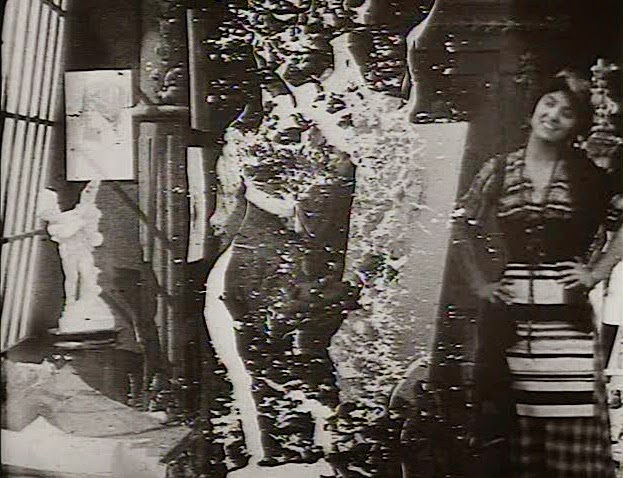
Decasia (Bill Morrison, 2002)


(written for a MovieMail podcast in 2007)
_________________________

I was watching FW Murnau’s Nosferatu in a cinema a few years ago when something quite unexpected happened. It occured on the first night in Orlok’s castle, just after Hutter has cut himself with the bread knife on the stroke of midnight. Count Orlok extends his arm towards Hutter across the table. All of a sudden, the Count's arm started bubbling and fizzing. It was as if the poison of the vampire’s presence was eating away into the very medium that was depicting him. Though I’m sure whoever owned the print would have been horrified at such a sight, I was thoroughly delighted by such an apposite coincidence of print damage and subject matter (possibly because I had made similar experiments myself with 35mm transparencies many years previously). That’s by the by however, the important point is that it raised in my head a large and generally unexplored area of effect in film, whereby degraded and otherwise abused film stock could be used to heighten certain effects within what the film itself showed. You can imagine my happiness then on finding that Bill Morrison had made a film in exactly this area, Decasia, in which he pieced together what would normally be considered as utterly ruined sections of film stock to create a new film in which the interplay of surface damage with the subjects depicted became part of the film’s overall conception.

I’ve mentioned the happy accident of effect in Nosferatu. Decasia is filled with such images. At one point in his film there is a section of what looks like white-robed dancers of some kind, or even the meeting of a witches’ coven – it is extremely difficult to make out exactly, but that's beside the point. What it could be however, is one of the most atmospheric and mysterious representations of the meeting of the three weird sisters out of Macbeth that I have ever seen, with their ghostly, misty forms being more air than solid matter. These ghostly forms occur frequently throughout the film. Often the film is slowed down to the level of individual frames and so becomes a collection of phantoms, spectres, and ghoulish distorted presences. There is more to unnerve here than in many more traditional representations of ghost stories on screen.

Death imbues its presence throughout the screen. At one point we see standing nuns depicted in negative. This reversal is shocking and, with the line of children they are shepherding pictured advancing towards them, turns them into angels of death counting departed souls instead of anything particularly beneficent. Later, riders on a big wheel at a fairground are subject to a similar sinister operation as an enveloping blackness clouds across the image. The accompanying horn blasts on the soundtrack make it seem as if some deity or other is dispensing random, indifferent fates to the riders – this one, this one, not this one.

This darkness covers the sea too. We see footage shot from the mast of a ship, the film recalling Der Magische Gürtel, the First World War record of a U-Boat’s matter of fact destruction of merchant shipping. That film is shocking because the sinking of ships and goods is so plainly shown. Here, with bow of the ship shown in negative beneath swathes and swatches of damage, it appears as if it could be one of the very merchant ships destroyed, and heading towards its destiny.

This interplay between surface and image throughout maintains constant interest. After the whirling dervish at the commencement of the film (which sets up one of the film’s recurrent visual themes of spinning, turning and spooling) there is then a puff of cloud like an effect in an early Ali Baba film, after which the clouds gradually roll back to reveal the delights on offer. Later, in a shot of waves breaking on rocks, the surface of the film itself bubbles and cockles in liquid ferment. In the final section, as parachutists are pictured falling through the air – which is at the same time an exercise in falling through the uncooperative texture of decaying nitrate film, the film moves into a tracking shot as a black sun glints through the trees on the horizon. he parachutists have established a wartime theme, and suddenly the film itself erupts in shapes reminiscent of WW1 bomb blasts, followed by their spray of dirt.

There’s humour here too though, as with the boxer battling with the damage itself (and landing a knockout blow that causes the film to erupt into another scene); the painter in his studio where the damage of the print can stand for either the white heat of creative composition or the fact that he is so perturbed by his model that he is in a stew; and the miners knocking to see if they can hear life below, with the print damage resembling the noise waves that give them hope.

Tthere are some exquisitely lovely images too, such as the shot of people and camels travelling across the horizon, in a scene that calls to mind something similar in Werner Herzog’s The Enigma of Kaspar Hauser. The nitrate damage also has its own beauty regardless of interplay with the images it obscures. At times it is like watching a monochrome Stan Brakhage or Norman McLaren film.

In fact, one becomes a connoisseur of damage and patterning watching Decasia, watching the different effects, the filigree and the fronds, the coral and speckle and blotch and smudge, the solarisation and flare, the snakeskin patterning and staining, the wrinkles and buckles, the scratches and the scumbles, tears, blisters and puckers, the bubbling, the bloating and the crimping.

At the end of the film, the dervish is still turning, as if he is spinning his own decay, or even trying to prevent it as long as he keeps moving.

The Third Part of the Night (Andrzej Zulawski, 1971)


(written as a review for MovieMail in 2007 and also used as part of a MovieMail podcast in 2008)
_________________________

A disorienting, disjointed fever dream in which colours convey as much of a route to truth as words, this charged, supernatural film of the Resistance and lice-feeding in wartime Poland has an unruly energy that frequently erupts into spasms of violence, but just as often produces scenes of eerie, surreal beauty. Bookended by readings from the Book of Revelation, it portrays a country during a time of doom-laden darkness.

In a country retreat, Michal witnesses the brutal slaughter of his wife Helena and child Lukasz at the hands of armed horsemen, though his wife seems to expect her death and even dresses for the occasion. After laying their bodies out with his father, who intones a Black Mass, (‘Oh God, who does not lead us … oh God, who allows the fragile to be killed and who elevates blind hatred … oh God, who allows cruelty to be propagated and people to torment each other … oh God, who elevates the most evil ones and puts the whip in their hands … oh merciless God, have no mercy upon us.’), he escapes to the city, takes refuge for his life in an apartment, and there aids a birth by a woman, Marta, who seems to be an incarnation of his wife. He spends the remainder of the film unwittingly chasing after his own death, surrounded by symbols that he only dimly grasps. And if this sounds portentous, it is offset by a memorably lurid stylisation more asociated with Hammer horror, by the punctuation of occasional fuzz guitar in the soundtrack and some thrilling, involving, hand-held camerawork around and through the back streets, alleyways and institutes of Krakow.

This freedom of mobility in the camerawork (by Witold Sobocinski) gives the film a visceral, emotional impact well suited to the strange reality of the film’s subject. Zulawski talks of feeling liberated from any academic tradition of cinema when making the film, and away from the dead hand of party interference, he, along with his cast and crew, also felt freed from producing anything ponderous or mannered – though given the story, based on a script by Zulawski’s father about his experiences in wartime Nazi-occupied Poland, this would have been unlikely anyway.

It takes as its central situation, and metaphor, that of lice-feeding. (Says Zulawski of this, ‘The second world war seen through a microscope about lice sucking blood from very naive young people seems to me, up to today, as interesting at least as the battle of Berlin, planes, tanks…’) Curiously, for this is certainly the strangely unsettling part of the film, it was a situation based on fact. During the war, Polish intellectuals found shelter of a kind with the Rudolf Weigl Institute, which manufactured typhus vaccine for the German armed forces. As is depicted in the film, lice cages were attached to people’s legs to fed on their blood. They were then injected with typhus germs which bred in the lice’s intestines, and these intestines were then processed to obtain the vaccine. Those people working at the Institute and infected with typhoid were shunned as untouchables by the Germans and provided with papers that were good against deportation, arrest and hunger. As an apparition of Marta explains to Michal while he is feeding, ‘lice are important as they keep you alive’. As lice-feeding only occupied an hour or so of the day (though the itching lasted much longer), it thus became a convenient core of resistance activities, with which, in the film, Michal becomes involved.

These experiences of a bureacracy dedicated to the nurture and use of lice are expertly and consistently realised on screen, from the shots of the equipment used and the microscopically detailed close-ups of procedures with the lice, to the feeders’ feverish and reddened eye-rims standing out against the background of dingy mustard-yellow walls in the Institute. Despite their being based in fact, it is the matter-of-fact acceptance from all the participants of the oddness of the situation that makes these scenes seem so surreal.

Of course, the skein of the film’s story is also at times twisted and tightened into something far more maniacal. At one point in the film, a lice-feeder says that he will feed well today because he is feverish; ‘Feverish blood has bubbles and it fizzes like champagne,’ he says. The film itself is somewhat like that; its images get under your skin like the fever from a biting louse, and begin to work on your imagination. It’s not a film you can forget.

I said earlier that colour held as much of a clue to the film as words. Against the film’s consistently blue-grey pallor – the blue of oily smoke from cars, of ash and wet pavements, railings and rain and reinforced glass, there is the purity of Lukasz's cornflower blue outfit, an unsullied purity of colour that amounts to something like moral justification and encouragement.

The lice that keep Michal alive, for a while anyway, in the film, are representative of the lice that kept Zulawski’s father alive during the war. When Zulawski says, ‘the blood of contaminated lice flows in my veins,’ he is only partly joking.

Dust Drifts Through Sunlight: Into Great Silence (Philip Gröning, 2005)


(the poem Dust Drifts Through Sunlight appeared in Artesian 3: Time (2011), while the text was written as part of a podcast for MovieMail in 2007)
_________________________

dust drifts through sunlight
like snowfall, the cell’s bare wood
lit with flame, orange as a crocus

·

a warming chimney ticks its heat
as air draws through the stove,
twigs crackling like snow-melt

·

a bow saw snags in a beech log
ringing out the weight of its warmth
through these mountain walls

·

their grain sung into being by woodland birds
floorboards creak a man’s weight
as chaffinch song tumbles through tea wisps

·

cell windows open at dusk to the grain of the sky
this cowl is stone and book paper
winter mist, a dawn dark stream

·

rain drops imprint themselves in water
as bells scour the corridors and chambers
their green stone a river in flood

·

wetted fingers to a white cloth
leave it transparent to the light
an airy pendulum dried by the breeze

·

around the monastery
stars fall like snow
silently through the sky

·

around the monastery
stars fall like snow
silently through the sky


In 1984, Philip Gröning asked for permission to film life inside La Grande Chartreuse, the mother house of the Carthusian Order in the French Alps. Sixteen years later, he was granted a unique shooting permit. As no visitors or tourists are allowed on the premises, and the last shots from inside the monastery were taken in 1960, (and these were only permitted as long as no monks were depicted) this was a rare opportunity, based on a longstanding and trusted relationship between Gröning and the General Prior, to show the daily rituals and requirements of a cloistered, contemplative life. The Prior’s only restrictions on the film were that no artificial light should be used while filming, there should be no additional film crew, and the film should have no additional music and no commentaries – conditions which corresponded exactly with Gröning’s original concept of the film, and to which he readily assented.

Into Great Silence is almost entirely without speech. Instead, usually overlooked sounds come to the fore – the draw of air through a fire, the crackle of wood, the pendulum of a clock, even the falling of snow. Surprisingly, instead of making this a somnolent film, it heightens your awareness so you are receptive to the smallest noises, and even to the atmosphere of silence. Indeed, when a louder noise such as a bell rings, it has a startling effect. Gröning talks of the monks being in a state of permanent concentration due to their regime, in which every moment is filled with tasks, duties and prayer, and in which they never sleep more than three hours at a time. The heightened awareness that this ordered life brings is one area in which Gröning has achieved his stated aim of going beyond mere depiction of the monastery to create an absolute congruence between content and form, so that in a way, the film actually becomes the experience of the monastery, an experience in which the viewer is thoroughly immersed.

At one point, late on in the film, an elderly blind monk says that, “the past is human. In God there is no past; solely the present remains.” This partly communicates the experience of watching the film, in that it takes place permanently in the present. Curiously, this effect is enhanced by the repetitions of actions we see and hear throughout. Sometimes, Gröning varies the form, as when sounds heard earlier in the film are repeated with different, allied images. This is done with a light touch, as when we hear the sound of a washed metal bowl settling to drain allied to a shot of water drips.

There is nothing in the film that is unrelated to its overall conception. Even relaxed or apparently picturesque moments serve a purpose. Throughout we see sunlight illuminating the wooden surfaces of the monks’ cells, the floors and the stone walls of the cloisters, on the monks’ faces, and on fruit. The images are pleasing in a conventional sense but they also serve to illustrate a lesson that we learn about some way through the film, when a monk talks of equating the holy spirit with the sunbeam, and that as the sun shines on all equally but brings light and happiness to individuals, so the spirit gives to each one as if it were in possession of that person alone. From that moment the sunlight that floods the desks and benches, floors and walls, making the wood glow orange, takes on a symbolic hue and turns the film itself into a lesson. More literal lessons are written on the screen and repeated throughout the film, reflecting the recurrent psalms that inform a monk’s life, and in which insight is gained through repetition.

As a moment of relaxation and a change of palette, Gröning inserts a rural interlude in which our eyes are refreshed by the green of spring fields. This is a visual equivalent to the lesson that we have heard earlier in which the Order recommends a walk in the country once a week as a refreshment from the rigorously austere routines of the monastery. It is a nice touch that it is on one of these walks that we hear the monks discussing the importance of living symbolically.

We follow the monks’ lives through the seasons as they live, pray, work, and in one sequence that is surprising (but given the blind monk’s talk of happiness, really shouldn’t be), play in the snow. As Gröning says in his notes on the film, this is a demanding lifestyle with continual claims on your time – a lifestyle in which he partook whilst filming, as he lived in a cell and joined in with the daily routines, formed by necessity and prayer. It is no coincidence that a sound we hear repeatedly throughout the film is that of air drawing through the fire in a burner, which is an object of central importance in each monk’s cell. If the fire goes out, it gets cold (the monastery itself is 1300 metres up in the Charteuse mountains), so you keep the fire in. It allows you to pray.

Of the many images I can call to mind from the film, there are two which keep coming back to me, both of which are related to temporality, impermanence and an eternal present and which can remain as visual lessons in contemplation to return to time and again. Like any good lessons too they are profoundly simple. The first is motes of dust in the air, illuminated in a ray of sunlight. The second was filmed through the course of one clear night, in which time-lapse photography makes the stars of the universe fall like snow, silently across the sky above the monastery.

Shoah (Claude Lanzmann, 1973-1985)


(written for a MovieMail podcast in 2007)
_________________________

Marcel Ophuls called at Claude Lanzmann’s Shoah ‘the greatest documentary about contemporary history ever made, bar none’. It is a film of active listening made by a man trying to understand an archaeology of genocide, of the systematic destruction of Jewish people in Europe during the second world war. Its title, ‘Shoah’, comes from the Hebrew word used for the Holocaust, and which can be translated as ‘catastrophe’ or ‘annihilation’.

I’ll begin with a quote from Simon Schama, who, in his 1995 book Landscape and Memory, describes his visit to Treblinka. He says, ‘In our mind's eye we are accustomed to think of the Holocaust as having no landscape – or at least one emptied of features and colour, shrouded in night and fog, blanketed by perpetual winter, collapsed into shades of dun and grey; the grey of smoke, of ash, of pulverized bones, of quicklime. It is shocking, then, to realise that Treblinka, too, belongs to a brilliantly vivid countryside; the riverland of the Bug and the Vistula; rolling, gentle land, lined by avenues of poplar and aspen.’

This is partly what does Claude Lanzmann does in Shoah, he shows locations, people, hears eye-witness accounts – from survivors, from nearby villagers, from farmers who worked near the camps, and unremittingly pursues telling details on a human scale. These details are important. We hear from men who had to dig up the thousands of corpses so that these could then be burned. As it stands, horrific as it is, this last sentence can be read without comprehension of what this involves. The details – that the workers had to open the graves without tools, with their hands (and were told they should get used to it), that the deeper they dug, the flatter the corpses were, that when they picked up a body it would sometimes crumble in their hands, that they were ordered not to refer to the bodies as corpses or victims, but instead as ‘figuren’ – dolls, or shit, or rags, that when these bodies were burned, they burned in flames of every imaginable colour, flames of red, of yellow, green and purple – these are the details which ground the events in the everyday, making such systematic destruction of life simultaneously more comprehensible and more terrible. These are the details that should never be lost. Similarly, one of the first men we see in the film, Simon Srebnik, a survivor of Chelmno, talks of human bones that were too large to be succesfully burned, such as the large foot bones, which were instead ground to a fine powder and taken in sacks to be emptied into the Narew river. Much of Srebnik's testimony was not used by Lanzmann as it was too graphically disturbing and would have not achieved his purpose of transmission – transmission of facts, details and evidence. The fact of a foot bone is what sticks in the mind longer than numerical abstractions. As Lanzmann says, ‘Shoah is a fight against generalities’.

In this ‘fight against generalities’ we hear SS officer Franz Suchomel, secretly recorded, saying that on his first day in Treblinka, he saw people fall out like kartoffeln – potatoes – from the gas chambers. This descriptive detail is echoed by Filip Mueller, a worker in the ‘special detail’ in Auschwitz, who talks of the sight of people after the opening of the gas chambers. People, he says, ‘were packed together like basalt, like blocks of stone’. When they fell out of the chambers, they fell out ‘like rocks out of a truck’.

We learn the sardonic language of Treblinka (described by Suchomel as ‘a primitive but efficient production line of death’); the ‘infirmary’ was a 12 ft deep pit of corpses, where the elderly and infirm were taken to be ‘cured with a single pill’ – shot through the neck as they stood or sat on a board over the pit. We learn too of the signs and posters in the undressing room at Auschwitz, made to look like an ‘International Information Centre’, to persuade people that the ‘disinfection’ process was just that: ‘Rein ist fein’ (‘Clean is good’), ‘Lice Can Kill’.

Sometimes the words used in the interviews shade into the language of politicians. Franz Grassler, Nazi deputy commissioner of the Warsaw ghetto, says that although the ghetto was being ‘maintained’ to supply a working Jewish population, the fact that 5,000 a month were dying there through starvation and disease was ‘a paradox’.

Grassler also provides a valuable insight into the workings of memory, when he says that he recalls his prewar mountaineering trips more clearly than the Warsaw ghetto and the entire war period’. For him, the ability to forget is a luxury. It is certainly a luxury out of the reach of Simha Rottem, a survivor of the Warsaw ghetto, who says to Lanzmann, ‘if you could lick my heart, it would poison you.’

The historian Raul Hilberg sets the persecution of Jews in the context of centuries of European anti-semitism. He says, ‘I’ve avoided asking big questions, in case I get small answers’. Again, this resonates with the approach of Lanzmann, who asks simple, candid questions of those left to bear witness: ‘Where are we now?’, ‘Why did he make that gesture?’, ‘Did the farmers continue to work the fields near the camp?’, ‘Did the locomotive driver hear screams?’, ‘Did the farmer understand the Jewish language?’, ‘Was it a fine day?’, ‘What colour were the gas vans?’. By doing this he has created a film of active listening made by a man trying to create a historical record of an archaeology and an oral history of genocide, the systematic destruction of a people.

Some of the answers are unpalatable, not through detail but through a dismissive attitude. The wife of a Nazi schoolteacher in Chelmno says of the Jews chained in workgroups in the village, that it ‘gets on your nerves, seeing that every day … day after day, the same spectacle’. When asked how many Jews were killed in Chelmno she is unsure if it is 400,000 or 40,000, ‘I knew it had a four in it,’ she says. However dismaying or unpleasant the answers are, this is valuable and revealing oral history.

Lanzmann insists that his film is a work of art and not merely a documentary. Certain sequences are testament to this, for example the interview with Abraham Bomba in a barber’s shop as Bomba tells of cutting people’s hair inside the gas chamber at Treblinka. There is a palpable tension as Bomba tries to tell the details, loudly and publicly as he cuts a customer’s hair, without breaking. It is an undeniably powerful sequence that imprints his story more thoroughly on the viewer’s mind. Crucially, it does not get in the way of ‘transmission’, which for Lanzmann is key. When asked why he filmed Bomba cutting a man’s hair instead of a woman’s, as he would have done in Treblinka, he says that ‘It would not have transmitted … would have been obscene’.

There are details which beggar belief in the film, such as the Gestapo organising group or excursion fares with the German railways for Jews travelling to Treblinka, as 400 or more passengers travelling together went at half-price, as did children under 10 on normal trains. Children under the age of 4 went for free. The money for the transport came from the Jews’ belongings. It was, as Raul Hilberg says, ‘a self-finacing operation’ on the part of the Gestapo as there was no budget for such destruction.

At one point the camera accompanying Lanzmann glides into a bar to interview former SS officer at Belzec Joseph Oberhauser, who refuses to answer any questions other than how many quarts of beer he serves. The camera’s movement unnervingly recalls its earlier glide through the gate, around the building and into the Auschwitz crematorium's incineration chamber, as Filip Müller describes his first experience of the place, noticing the low building and the smokestack.

A screen of trees in Sobibor, planted as 3 or 4 year old saplings over mass graves, are filmed as mature trees in the golden hour before sunset. Again at Sobibor, the camera films the surrounding woodland, leaves rustling in the trees, on a beautiful day. ‘I suppose there were fine days like today?’ Lanzmann asks a man who worked in the railway station. Yes, even better days than this, he responds. This placing of such destruction on indifferently beautiful days is disconcerting, but is backed up by Simon Srebnik, who, when he revisits the site of the extermination camp at Chelmno, talks of how the extermination happened on some days. ‘No one shouted, everyone went about his work. It was silent. Peaceful.’

Lanzmann walks the land of the camps, drives the roads on the routes gas vans took, rides the rails and travels the waterways. By showing us these places as they are now, he has made a film that can change your relationship with the landscape and adds significant depth to the experience of knowing Europe, from the shoreline of Corfu to the forests of Poland. It makes you poignantly aware of the memories buried in the land, in the grass, the now anonymous fields and the trees; in the buildings – the churches and synagogues where people were held, the offices where bureaucrats signed forms and organised special trains, the travel agents where special rates were arranged, the rails on which people travelled and the stations where they were processed, and the balconies of houses from where people watched Jews being collected together for transportation, and behind net curtains where people watched chained work gangs walking down the street. It also makes you aware of the memories held in people’s minds, behind the faces and expressions that you meet every day.

Throughout the film we hear the breeze rustling the leaves of the trees, as if the very land is trying to tell us its story. This happens on the river near Chelmno and in Grabow, and on the drive through the forest outside of Chelmno. The autumn leaves rustle in Treblinka, near the station and as the camera moves through the stones that form part of the Treblinka memorial, and the leaves whisper around Bełżec.

After nearly 10 hours of film and testimonies from death camp and ghetto survivors, locomotive drivers, SS men, railway workers, villagers, I am left with the feeling of just how little I have heard, how few individual histories have been told, and how many millions of experiences never now will be told.

Tuesday, 18 November 2014

‘Try a Little Tenderness’: Some Films by Albert & David Maysles


(written for a MovieMail podcast in 2007)
_________________________

I started watching Salesman late one evening, not expecting to see it through to the end. After all, a 1960s documentary about Bible salesmen couldn’t be that interesting could it? Was I ever wrong. Within a few minutes I was hooked, stayed right to the end and then watched it all over again the next day. I should have known better of course. After all, I had seen and adored the Maysles’ films about Christo and Jeanne-Claude, but those were about a subject I was predisposed to and about artists in whom I was interested. Curiously, this blinkered me to the inherent qualities of the filmmaking involved. It’s interesting that it took a film about a subject from which I am (at least) twice removed in interest (selling and religion), to make me aware of the Maysles’ craftsmanship.

About Salesman, their narration-free documentary portrait from 1969 of door-to-door salesmen from the Mid-American Bible Company, as they go about their business of selling lavish bibles to low and middle-income Catholic families, Norman Mailer said, ‘I can't think of many movies which have had as much to say about American life and have said it so well.’ The film follows four of the salesmen, The Badger, the Gipper, the Rabbit and the Bull – their names reflecting their selling styles – and travels with them from Boston to Florida as they deliver their pitch: ‘it'll be an inspiration in the home’, ‘it’s still the best-seller in the world’. Yet for all the talk of placing something of lasting worth with families, there's an air of unease that accompanies selling to those that can ill afford the $49.95 (and this is the 1969 price) for a bible (‘it comes in red or white’). At the end of the day – which is when we see them discussing their sales in cheap motel rooms – it’s all about selling bibles on commission for dollars and cents: cash, COD or Catholic Honor Plan.

One salesman isn’t delivering. ‘Any man that's not good at sellin’ should be good at makin’ excuses’ says their boss. And ‘the Badger’, Paul Brennan, has plenty of excuses. He ‘couldn't find the houses’, ‘couldn't get in the doors’, ‘couldn’t get no pitches’, ‘couldn't get the old Mickey stuff to work’. His colleagues, still pulling in the sales, laugh along for a while until embarrassment sets in and they start to fidget and avoid his eye. One says that he's putting people in a bad frame of mind. ‘You’re fightin’ em, the people can spot it a mile off.’ The Gipper takes him along on a call of his own to try and shake him out of his negative attitude. It’s all running along just fine until Paul makes a badly-pitched and somewhat desperate interjection and ruins an easy sale.

As observational documentary, or ‘direct cinema’, Salesman is peerless. Though the term ‘fly on the wall’ documentary is misleading in many cases, presupposing that the presence of a cameraman and sound recordist has no affect on the events and conversations depicted, in Salesman, it at least conveys a sense of the physical limitations of the rooms in which the salesmen were filmed. The Maysles had been door-to-door salesmen themselves and knew and understood the world. That they managed to be such a remarkably unobtrusive presence in the confined spaces of motel rooms and people’s houses comes from a crucial empathy with their subjects that allowed them to get so close. Very few people can make this kind of film as it comes from connections on a level outside of the camera. ‘I have a genuine fondness for people,’ says Albert. It shows. In combination with David Maysles and Charlotte Zwerin’s highly-accomplished editing, it’s one of the reasons why apparently mundane scenes are so memorable, staying with you long after you have seen the film. 

Salesman is listed in the Library of Congress National Film Registry as one of America's most important films. With its portrait of a redundant occupation and its subject matter of the intersection of commerce and religion, this is not surprising. (Says the salesmen’s manager Ken at the sales conference: ‘Money is being made in the bible business…and all I can say to people who aren’t making the money – it’s their fault.’) However, despite all the pep talks in the film, what lingers from the film is a sense of melancholy borne of sham transactions. In this regard, one scene stands out. As the Bible salesmen at the sales conference in Chicago make their ever-increasing income pledges for the coming year, Paul Brennan, the Badger, is shown on his way to the conference, staring out of the train window. The speakers at the sales conference talk over his thoughts, while the sound of wheels on rails plays underneath the speakers at the conference, adding their own plangent undertone to proceedings, reminding us of the long hours, the travel, the hustling, the homesickness and the two-bit rooms reeking of stale cigarette smoke, which everyone in the sales meeting has forgotten, just for a little while.

This empathy, understanding, love, forbearance, tolerance, call it what you will, with their subjects that I have mentioned is crucial to the Maysles’ films. It’s there in Grey Gardens, their 1975 film about the Bouvier Beales – ‘Big Edie’ and ‘Little Edie’, eccentric aunt and first cousin respectively of Jackie Onassis, dropouts from high society living out their mother and daughter theatricals in their dilapidated, flea-ridden, garbage and cat-filled mansion from whence the film gets its name. Continually bickering, performing their private dramas, singing, entertaining, leafing through past photographs and telling their stories, feeding their cats and raccoons, they put on a show for the camera and the tape recorder. Material like this could so easily be exploitative, and many of the scenes are almost painfully intimate, but the almost certain knowledge that the Beales would have themselves presented no other way hauls you back from making rash judgements. The Maysles were making a film with the Beales, not just of them.

Talk of making films with rather than about leads us directly to a relationship that covered 5 films and over four decades of friendship, between Albert and David Maysles and the artists Christo and Jeanne-Claude. Said Albert of their relationship: ‘The four of us were a twosome’.

Briefly, since the 1960s, Christo and Jeanne-Claude have undertaken large scale environmental art projects that temporarily transform landscapes or buildings, typically by the use of fabric of some kind, sometimes wrapping or surrounding landmarks or buildings, sometimes suspending fabric from man-made structures. Out of their many projects, probably their most well-known works involved wrapping the Reichstag in Berlin in 1995 (a project that took 24 years to come to fruition) and warpping the Pont-Neuf in Paris in 1985. One of their most recent projects was The Gates, Central Park, New York, 1979-2005, in which 7,503 16ft high gates were positioned along the walkways of Central Park and hung with saffron coloured fabric panels for 16 days. In all of their projects, Christo and Jeanne-Claude accept no sponsorship or donations of any kind, and finance the project entirely through the sale of preparatory studies, drawings, collages and scale models of the project. The works are temporary, and at the end of each project, the sites are restored to their original condition or better, and most of the materials are recycled. In response to a question about how much the projects cost, Jeanne-Claude responds that ‘every project costs the same thing – everything we’ve got plus everything we can borrow’.

There are five films on the 5 films about Christo & Jeanne-Claude collection; Valley Curtain from 1974, about Christo’s draping of a quarter-mile wide orange curtain in a Colorado valley; Running Fence, from 1978, about the siting and erection of a 24½ mile long drape of white nylon fabric through Sonoma and Marin counties in California; Islands (1980-83) in which eleven islands in Biscayne Bay, between Miami City and Miami Beach, were surrounded in hot pink fabric; Christo in Paris (1990), which is a record of Christo and Jeanne-Claude’s project to wrap the Pont Neuf in golden fabric but also a record of the couple’s love affair, and finally Umbrellas, from 1992, a project about ‘comparison’ in which thousands of large umbrellas were situated throughout two valleys, one in California and one in Japan.

There are no expert talking heads and not a critic in sight; they are all simply unnecessary to the remit of Christo and Jeanne-Claude’s art. Instead the films concentrate on the projects themselves and the characters involved in their creation. Take the first two projects they document – Valley Curtain and Running Fence. The first was a 381m wide by 111m high orange curtain suspended in a Colorado valley and looking like a huge happy orange grin when unfurled. Even though the Maysles were only around to film on the last two days of the project, it’s enough to see that the steel workers and engineers have made it a point of pride to get the thing up and fixed into place. They share the project entirely, share the nerves before the unfurling and the beauty and triumph when it is unfurled. 

Running Fence was a 24½ mile long, 18 ft high nylon drape running through two counties of California and on into the sea. It was up for 14 days. In the film we are taken through the planning meetings with sceptical councillors and landowners, the special hearings and get to gauge the balance of public opinion. Amazingly, down-home ranchers are soon adopting the scheme of this long-haired, heavily French-accented Bulgarian man as their own and become determined to see it through against opposition. This is all part of Christo and Jeanne-Claude’s art of course – a democratic, public consultation of which the final works are an ephemeral expression, art in which ownership is shared and enjoyed by a community.

Time and again we see people wanting to get close to the art, enchanted by the pull of a combination of ephemeral beauty, good design and practicality. In Running Fence, one of the ranchers on whose land the fence is sited, after appreciating how firmly the poles are fixed in the ground, says ‘I think I’m going to come and sleep up here tonight, it’s so nice, sleep right up next to the fence.’ A similar sentiment comes in Umbrellas, in which a group of Japanese children agree that they would like to eat lunch under an umbrella, following it up by saying thay they should sleep under them. We then see them crying for the sheer unexpected beauty of the blue umbrellas, an effect we also see later in California as a woman looks at the yellow umbrellas, blooming like bright desert flowers after the rain.

It’s easy to see why the Maysles and Christo and Jeanne-Claude were such a good fit; Christo and Jeanne-Claude’s art is about nothing if it’s not about making connections between people. In fact, there’s an awful lot of congratulatory hugging in the films between people you wouldn’t expect. Sometimes the praise is highest when it is most understated. When, in Umbrellas, a grounded Californian landowner says the words ‘Yeah, I think the man is alright’, that really is praise indeed that bridges all sorts of divides and makes a connection on the level of the heart.

I have said little or nothing about the Maysles’ filmmaking style – which only goes to show just how thoroughly self-effacing it is. However, I would like to repeat a point that Jeanne-Claude makes in her commentary on Valley Curtain, where she draws attention to a lovely piece of editing. At one point Christo is talking to an engineer on the project, who is smoking a cigarette. As they finish their conversation, he takes a draw on his cigarette, the tip of which glows orange, before the screen is suddenly flooded with the orange of the fabric that Christo is cutting. The films are filled with tiny, beautiful details such as this.

It is Jeanne-Claude who provides one of the most telling lines of the documentaries and one that goes to the heart of their art. In Islands, she says to a sceptical councillor, ‘How many children wake up early on a Sunday morning begging to be taken to an art gallery to see if a picture is still there? That’s what they will do if we wrap these islands, they will beg their parents to take them.’ For those of us who weren’t there, these heartening, uplifting documentaries partake in that same magic.

On the 5 films about Christo & Jeanne-Claude collection, there is an interview from 2003 between Albert Maysles, Christo and Jeanne-Claude, in which they talk of their friendship and the flms thay have made together. It’s instructive in a couple of ways. Firstly it shows Albert Maysles sitting back listening, calmly and comfortably, not interjecting but waiting for the appropriate moment to tell a story. You can imagine his presence like that when he is behind the camera. Secondly, the conversation moves onto what is central to the films they made. As Albert says to Christo and Jean-Claude, ‘the central thing in any work of art is the love, the human affection … the love for the projects, the films and for you guys’. I want to finish though with what Jean-Claude says in response to this when they talk of the film Salesman. She says that in a discussion about the film, someone complained that in that film the characters were all so unsympathetic, to which Albert responded, ‘try a little tenderness’. Amen to that.

Norman McLaren: Camera Makes Whoopee!


(written for a MovieMail podcast in 2007)
_________________________ 

When asked how he would like to be remembered, Norman McLaren said, with characteristic modesty, as ‘an innovator of new techniques, some of which led to a few distinguished or interesting films’. A dip into any one of the seven discs that comprise Norman McLaren: The Master’s Edition, which showcases the spread of his films from his work for – and even before – John Griersons GPO Film Unit in the 1930s, through his wartime films, his joyously free postwar interpretations of music from Oscar Peterson to Québécois folk song, his experiments with synthetic sound and his sublime late-career ballet films, reveals the complete inadequacy of this statement.

However, out of all the wonders on display in this set, I’ve found that it has been one of the least likely titles that has captured my attention and stayed with me. It’s the series of five short programmes that McLaren made with Grant Munro between 1976-78 and entitled simply, Animated Motion, in which ‘McLaren comments on, demonstrates and classifies aspects of motion which the animator employs in his everyday work’. With the aid of little more than a white disc on a black background, the two animators methodically go through the absolutely basic techniques available to the animator to create the illusion of motion, demonstrating the different effects – and crucially, the different emotional effects – to be had from varying the tempo of movement. From constant movement, showing what movement looks like at different speeds – 32, 64, 128, 256, 512 frames a second for example, they then take in accelerating, decelerating, zero and irregular motion as well as change brought about through colour and lighting. As McLaren says, it is through mastery of these that an animator brings ‘life, meaning, character and spirit’ to his work. All of this information is presented absolutely straight, with the most limited of resources and in the most methodical, even dry, manner. (It is, by the by, an essential introduction to the art of animation for any aspiring animators.)

Why did these programmes have such an effect on me? Very simply, because it was with a sense of awe that I realised that what I was watching was McLaren running through the techniques and the tools available to any animator. However, to transmute those most basic techniques into the rhythmic wonders and profound emotional content of McLaren’s work frankly borders on the miraculous and shows almost better than anything his stature as a uniquely imaginative artist.

He of course had great skills, empathy and understanding to bring to the service of his animation. This is evident in one of the interviews he gave (found on the set as one of the Window on Canada programmes) that demonstrated how he transformed a mountain landscape into one of continual metamorphosis with shadings and dabs of chalk to mark the subtle changes of the day as the sun rises and sets. It leads the interviewer to remark that McLaren could have been a quick-draw pavement artist – a statement with which McLaren agrees.

It’s evident too in the continually evolving world of his 1947 film La Poulette Grise, drawn in pastels and which calls Marc Chagall’s landscapes and fantasies to mind, or his 1966 film The Seasons, an unfinished film experiment, in which, through a series of paintings, he tried to catch the changing light and colours of Canada, with the results recalling the ethereal sky-scapes of Turner. On a different level entirely, his drawing skills are there in the flipbook sketches that form the basis of New York Lightboard (1961), designed to promote Canada as a holiday destination in a lightboard show in Times Square.

Crucially, there’s humour too in his work – plenty of it. In Rythmetic (1956) for example, numerals take on human and animal characteristics – and equals sign impatient for an answer quivers with agitation, a number 5 scratches like a dog with a flea. With McLaren’s accompanying synthetic animated sounds accentuating the humour of the sums in progress, it becomes a wonderfully funny exercise on the simplest of subjects.

The set is divided up thematically and also to highlight the various collaborations that were essential to his work, people such as composer Maurice Blackburn, animator Grant Munro and dancer Vincent Warren. One of McLaren’s most important colleagues however was fellow animator and artist Evelyn Lambart, with whom McLaren made a number of his most well-known works.

Of their collaborations, one of my favourites, and also one of the most minimal films that McLaren made, is Lines Vertical (1960). It’s accompanied by Maurice Blackburn’s perfectly fitting Japanese-styled keyboard music, and is rapturously lovely in the calm of its moving vertical lines against the subtly changing backgrounds of lilac to violet, terracotta to brick to plum. This is almost as minimal as animation can get (though as part of the experiments for the film, McLaren and Lambart did make a film with a single moving vertical line, before deciding to use several lines instead), though it’s worth remembering that this is a hand made film and also the product of months of work, in which lines were scratched into the emulsion of six-foot strips of film with three different thicknesses of knife, the finest of which kept breaking. Because of the inherent difficulty of scratching a perfectly clean line into film emulsion, which hardens as it dries, the lines sometimes have a ragged edge on one side. To me this is part of what gives it life as an exquisite film-object that represents both the thoughts and artisanal skills of its makers. 

Lines Vertical was to directly result in two more films – Lines Horizontal, in which the Lines Vertical was turned through 90 degrees and given a new accompaniment by folk singer and guitarist Pete Seeger. The filmmakers were initially drawn to the idea of this experiment because horizontal lines would implicate the existence of gravity in a way that the vertical ones would not. Because the rising lines don’t decelerate – or the falling ones accelerate – they have the effect of floating and denying the gravity that they have called up. The other film to owe its existence to Lines Vertical is Mosaic, and with this film you really do start to enter an area of innovative brilliance. Briefly Lines Vertical and Lines Horizontal were superimposed in an optical printer with only the intersections of their lines showing as clear dots. The play of these dots across the screen was then set to a selection of McLaren’s animated sounds, which here resemble a sort of cross between Victor Borge’s phonetic pronunciation, the muffled sounds of a squash court, puckered kisses and the amplified puttering wing beats of a trapped moth.

McLaren took this equivalence of image and sound even further, and probably to its logical end, in his remarkable film Synchromy, from 1971. With Evelyn Lambart in the 1950s, McLaren had worked out the different patterns of stripes that would lead to them creating different notes of animated sound on the soundtrack area of a filmstrip. In Synchromy, McLaren first composed the soundtrack music using these cards, and then used these same sound patterns to create their exact animated visual equivalant. It is a truly stunning concept which gave rise to the title of Gavin Millar’s documentary on McLaren that is included in this set and which was filmed as McLaren was making Synchromy in 1970. Millar’s film is called The Eye Hears, The Ear Sees. In his notes on the making of Synchromy, McLaren said that, ‘Apart from planning and executing the music, the only creative aspect of the film was the “choreographing” of the striations in the columns and deciding on the sequence and combinations of colours.’ Well, that and a uniquely inventive approach to the entire manufacture and use of animated sound and image.

At the foundation of all of McLaren’s art, is movement. As McLaren said, ‘every film is a kind of dance’ and being an animator was like ‘being a dancer at second-hand’. He talked of how, in his teens, before he went to art school in Glasgow, he would listen to music on the radio, shut his eyes and see ‘the play and dance of forms’. A few years down the line, this ‘play and dance of forms’ translated in to some of his most enduringly enjoyable films, among them Boogie Doodle, Blinkity Blank and Begone Dull Care.

With his exposure to surrealism, his approach to artistic creation was really liberated. He realised that ‘with surrealism you can after all change anything into anything’, and so he did, creating a world of constant transformation and metamorphosis. This is best seen early on in a film he made for the GPO Film unit called Love on the Wing. With its imagery of kisses, hearts, pillars, pipes, people, keys, locks, bees, flowers and candles, as well as teasing, mating envelopes, it was considered ‘too Freudian’ by the then Postmaster-General, who prevented its release. 

Boogie Doodle was inspired by the excitement McLaren felt on first hearing a boogie woogie tune. Here, the boogie is from Albert Ammons, and the doodle from McLaren. It’s a sort of joyfully unbridled courtship of suggestive shapes. If the Postmaster-General found the imagery in Love on the Wing a little too near the knuckle, it’s almost certain that Boogie Doodle would have incured his prohibition too. 

Blinkity Blank, which started out as an abstract film set to a mixture of Maurice Blackburn’s music and McLaren’s animated sounds, was actually the product of a flash of inspiration from McLaren, who realised that black leader didn’t need to be drawn on every frame (which was proving difficult anyhow), but could actually be incorporated into the substance of the film, thereby giving that film its special nature of images appearing in flashes that imprint themselves after-images on the retina.

With Begone Dull Care, McLaren and Lambart’s ‘caprice en couleurs’ set to jazz from The Oscar Peterson Trio, they made use of what fate sent their way too. They were working in an old dusty building, which initially they found a great hindrance to their work, especially when they dropped a section of carefully-painted film on the floor when it was still wet. On picking it up however, they found that the dust had created a texture on the filmstrip which they thought looked good. Thereafter, Lambart would collect different types of dust into small boxes, cataloguing them from smooth to rough for future use. The experience of the film is an all-embracing one of synaesthetic visual equivalence.

One person whose name I haven’t yet mentioned, but who was instrumental to McLaren’s career, was of course John Grierson. It was Grierson who, as one of the adjudicators of the Third Glasgow Amateur Film Festival, at which McLaren showed his experimental and joyfully wayward ‘symphony on the ciné-kodak special’, Camera Makes Whoopee!, derided the film as a jumble, before offering him a job at the GPO Film Unit, (and thereby ensuring that McLaren didn’t think too highly of himself when he took the position). One of McLaren’s straight documentaries for the Film Unit, Book Bargain, included in this set, about the processes behind the printing of a telephone directory, is a clearly presented, straightforward documentary that goes to prove McLaren’s statement that he learnt discipline at the GPO.

It was also Grierson who enticed McLaren from his penury in New York (where, as a committed pacifist, he had gone in 1939 to escape the war) to the National Film Board of Canada. Concerned that he may be used to make propaganda, Grierson reassured him that he was going there to inject a little lightness and fantasy into the predominantly factual nature of the Film Board’s output and he would be given the freedom to experiment. And so he did, for the next four decades of his professional life.

It seems fitting to end with a quote from Grierson, who summed up McLaren’s art by saying that, ‘If there is such a thing as pure movie, be sure that McLaren has been one of its greatest exponents’.

Norman McLaren, The Master’s Edition has 58 of McLaren’s complete films as well as numerous tests, outtakes and unfinished experiments, documentaries contemporary and modern, technical notes on the films and audio snippets of McLaren talking about selected works. I haven’t even mentioned famous films such as his Oscar-winning Neighbours, Le Merle, Pas de Deux and Narcissus. Suffice to say, if you are even remotely interested in the man and his work, this set handsomely repays the investment, as there are films here that you will be returning to time and again.