Wednesday, 19 November 2014

Black Sun (Gary Tarn, 2005)


(written as a review and podcast for MovieMail in 2007)
_________________________

Gary Tarn’s Black Sun is one of those films that, arriving unburdened with expectation, displayed its craft, honesty, modesty and beauty in such a way that it not only made the day a little better, but it has stayed with me and continues to glow its welcome light in my mind. It’s a film about a painter coming to terms with blindness and it is one of those rare films that you immediately want to tell others about and share with them.

The film tells the story of Hugues de Montalembert, a French painter who was living in New York in the 1970s. One night, out of nowhere, as he returned home, two burglars were waiting for him. In the confrontation that followed, one of the men threw paint stripper into his eyes. He tried to wash it out with water, but because of its nature it continued to burn into the eyes and could not be removed. By the following morning, his vision had gone completely.

Without a shred of self-pity, and in a very matter-of-fact way, which in no way lessens what is a profoundly inspirational story, he relates how he came to terms with his lack of vision. He tells of his early days of blindness, days in which he felt as if he had fallen ‘into a pot of dark honey’. He realised that things would change but that he would need patience. ‘Let’s do like an animaux’ he reasoned (and Montalembert’s lovely French-accented narration is not the least of the film’s pleasures), ‘sleep, wait, and don’t think, and don’t despair, it will change. Thanks God it has changed.’

In those early days when he was lying in his hospital bed, he would think about the blind. Where were they? In the run of normal daily affairs, or socially, how many blind people did he know, or even encounter? For him, as for the great majority of us I expect, the answer was none. He wondered where they all could be, and imagined them in a pit where society puts people that cause it inconvenience. Refusing the ‘protection’ offered to him by his friends and family as the surest route into that same pit, and fighting a primordial fear about going out into the world without sight, he forced himself to behave ‘naturally, and not blindly’ and to trust – himself, his instincts and other people. He had to learn everything again he said, but mainly ‘to walk alone’.

From then on, once he had conquered the worst fear of all, of initially going outside of his door, he continued to travel unaided through the world and found protection in life itself, or as he put it, he found a way ‘to dance with life’. When later he was robbed in Delhi airport, he found that everything was returned to him by beggars. On travelling for two months alone in the Himalayas, he said, ‘nothing wrong happened to me, absolutely nothing. On the contrary.’

In an extreme way that he never would have chosen he says that blindness led him to discover a profound truth about sight. As he says, ‘vision is a creation, not a perception ... people mainly use their eyes to avoid obstacles, not to look at the world or to understand something. Most people are not really interested in looking at all.’

Before his blindness, Montalembert’s life, as a painter and fimmaker, was based on seeing, on using his eyes (he had ‘the eyes of an assassin’ said a friend). Appropriately, composer and filmmaker Gary Tarn has created a film of intensified visual and aural beauty that approximates to what it is like to see through Montalembert's eyes. Images that show the shapes and the play of light, shadows, street scenes, reflections and faces comment, sometimes directly, sometimes obliquely, on Montalembert’s narration about the experience of ‘living in an abstract world’, composed mainly of sounds. The colour-manipulated scenes of life on a tropical island, where Montalembert wrote his autobiography, sometimes losing pages of writing because he did not know that his pen had run out of ink, are hallucinatory and recall Chris Marker’s travelogue Sans Soleil in their potency. The ending, simply that of a ferry leaving the shore, and turning to face the water, silvered with evening sunlight, is lovely indeed.

Some people may know the story already from Eclipse, the book that Hugues de Montalembert wrote in 1982 about his experience and trying to come to terms with the blindness. If that is so, then the film– made two decades later – may comes a quite a surprise. It comes from a different place and is very different in tone. Where the book is filled with details, the film has been purified to essentials; whereas in the book Montalembert’s relationship to himself, his new self and the world around him is still in the process of being formed and resolved (it was written in the years immediately following the attack and there is an obvious anger and frustration in his outlook), in the film his voice emanates a wisdom born of acceptance, resignation and the realisation that although there had been a rupture in his physical condition, his destiny had actually remained unchanged.

Tarn composed the film from a few hours of tapes that he had recorded of Montalembert talking about the events of his life. The sound of his voice in the film is soothing, rhythmical, the music fitting to its cadences. Edited down to 70 minutes, Tarn removed anything which didn’t advance the story or took it into areas of needless detail. The fact is that the story expands to one of universal meaning.

If you want an affirmative, uplifting and courageous tale that is neither sanctimonious nor saccharine, and leaves you considering your own attitude to life, and how little you really make use of all the senses you have, then this is it. Calling a film inspirational or heartening is normally to lay the dead grey hand of platitude upon it. Not so here – it would be impossible in a film so full of golden light. I watched it with the occasional tear rolling down my cheek, product of a number of emotions, but mainly born of a conviction, normally so dimly apprehended and so little acted upon, that life repays a hundrefold what you give to it.

Montalembert talks at one point of the sheer pleasure he gets from walking with a painter friend who describes the scenes in the street before them in wonderfully enlivening ways. Calling the world into being, into vision, in a way that makes it a gift to ourselves and others, is something we all can do every moment. And think how easily we can do that, having our own eyes with which to see.

Two African Films: Abouna (Mahamat-Saleh Haroun, 2002) & Waiting for Happiness (Abderrahmane Sissako, 2002)


(written for a MovieMail podcast in 2007)
_________________________

This week, I want to look at two films from Africa – Abouna (Our Father), which takes place in Chad and which was directed by Mahamat-Saleh Haroun, and Waiting for Happiness, set in Mauritania and directed by Abderrahmane Sissako. Both were made in 2002.

I had been reading Ryszard Kapuscinski’s writings on his life as a journalist throughout Africa, collected in his book The Shadow of the Sun, and it struck me that some of the essential experiences of the continent that recur through his book and which he communicates so well, provide a background that can help with a fuller understanding of these two films.

To set them into context I want to quote from Kapuscinski’s book. He is in Ethiopia, near Gondar, and he meets a man who is walking south. Why is he walking south? Because his brother had set out from home long ago in that direction. He has been walking a long time. He has come from somewhere in the Eritrean mountains. Says Kapuscinski of him. ‘He knows about walking south: in the morning, you must head straight into the sun. When he meets someone, he asks whether they have seen, or know, Solomon (that’s his brother’s name). No one is surprised at such a question. All of Africa is in motion, on the road to somewhere, wandering. Some are running away from war, others from drought, still others from hunger. They are fleeing, straying, getting lost. This one, walking north to south, is an anonymous drop in the human deluge flooding the roads of the continent, a deluge driven either by fear of death or by the hope of finding a place under the sun.
 
Why does he want to find his brother? Why? He doesn’t understand the question. The reason is obvious, self-evident, not requiring an explanation. He shrugs his shoulders. It is possible that he feels pity for the man he has just encountered and who, though well dressed, is poorer than he in some important, priceless way.’

Both of the films I want to look at today touch on themes of seeking and belonging, the physical and spiritual qualities that make a home, and the necessary quest that may take a person away from that home.

First Abouna. Abouna begins with a man walking across a sand dune, turning to stare into the camera (with a look that dares us to judge him and that, to me anyway, recalls the scene of Harriett Andersson doing a similar thing in Bergman’s Summer with Monika), before becoming resolute, turning and descending rapidly out of the frame as he walks down a dune. He reappears briefly minutes later and then disappears again, walking to the horizon. This is the father and this is the last we see of him. The film is structured around his absence.

His two sons, Tahir and his younger brother, the asthmatic Amine, soon discover his absence and try to come to terms with the unaccustomed void in their lives. They wait for him at the bridge that forms the border between Chad and Cameroon. ‘Over this bridge, you’re already elsewhere’ says Tahir.

They go the factory where he works only to be told that he hasn’t worked there for over two years; they go to the cinema and see him, or imagine him they see him, on the screen, greeting them, or his children in the film. They do not find him on the celluloid that they subsequently steal but it is this act of thievery that causes their mother- who has a wonderfully dignified, regal bearing – to send them away to a school out in the bush, to remove them from temptation. ‘Be patient,’ she says when she leaves them, ‘God is looking after you.’

From there the boys dream of escape and seeking their father. There is a lovely moment when Tahir is bathing in a compound. He drops his flannel over the wall as a girl in a golden dress walks by. In his confusion at her presence, he hides his face, calling out ‘what is your name?’ only after she has walked by. She walks on without turning round until even her shadow has disappeared. In the wake of his father’s disappearance it is a poignant moment, telling of how quickly people arrive and depart until even their shadow has gone and all that is left is a dusty street.

The boys try to escape but are caught. Tahir is shackled and is given a choice. If he swears not to run off he will be released. If he lies in his oath however, he is warned that even after he dies, his soul will continue to wander. This is a real and significant threat – to risk such a punishment would be tempting fate indeed.

When Uncle Adoum arrives to see them for a day, he brings news of their father. He is on the coast, in Tangier, and there is a tangible sense of excitement at discovering the fact of a placename, no matter how fruitless it may be. ‘Can we go there on foot?’ asks Amine. Uncle Adoum just laughs. Their father has sent a poster which the boys put up on the wall of their hut. It’s a picture of the sea and a beach. The fascination it exerts can perhaps only truly be felt if you live in a landlocked, largely desert country in central Africa. From this moment, water enters the film. While Tahir finds love at the river when he comes across the girl with the golden dress bathing, Amine – soon after he has discovered that his elder brother no longer wants to leave –  is taunted by the reminder of water as a man walks past him on a street with tins of water hanging from a yoke across his shoulders.

The remainder of the film I leave to you to discover. Needless to say, Tahir’s quest and coming-of-age involves both sacrifice and exchange, loss and gain, as all good quests do. It’s a simple tale that wears its large themes lightly. Ali Farka Touré’s understated musical accompaniment is distinctly appealing too.

Another recurrent theme throughout Kapuscinski’s book is that of waiting, or abiding. Time and again he talks of that particular class of benumbed waiting that attends an event dependent on attaining a quotient of people, whether this be a meeting or discussion taking place or a combi or taxi leaving for its destination. It is a type of waiting that confounds a European worldview in which time is to be used and controlled. I mention this because waiting plays a large part of the next film I want to look at, Abderrahmane Sissako’s Waiting for Happiness, which features a young man, Abdallah, who has returned to visit his mother in her Mauritanian village next to the sea, before he leaves. To go where is not specified but it seems that he is thinking of Europe. His mother’s village is a place of buffetting wind and white sand, a place of arrivals – a Chinese watch and trinket seller – and a place of departures, as inhabitants think of leaving for Tangiers, and then Europe.

He does not fit in to any life or patterns in the village. His apartness is emphasised right from the very start when we are shown the broken down taxi – the ubiquitous, fully laden, overcrowded Peugeot 504. The other passengers sit and wait in the shade in exactly the attitude that Kapuscinski describes. Abdallah wants to get on, wonders why the motor doesn’t go. He doesn’t know how to wait.

He does not even know Hassanya, the local language, which leads to a scene of excrutiating embarrassment when he sits with his mocking female relatives, naming body parts that he has been taught – wrongly – by Khatra, the electrician’s assistant. ‘He just sits alone’, says his mother, ‘he thinks all the time’. He reads too, which sets him apart from the oral traditions of song and storytelling in the community. These are exemplified partly by the singer Nèma Mint Choueikh and her young accompanist, an amazing young singer named Petite Mamma Mint Lekbeid, to whom she is teaching the songs through repetition.

What remains is for Abdallah to observe, to watch his neighbours – his view often obscured by lines of washing, walls and doorways – instead of engaging in any meaningful interaction with them. From his low window he starts to recognise people from their footwear, something especially frustrating as he watches them go to and from his neighbour Nana’s room. Even when he is in the doctor’s waiting room his attitude of waiting there is different. He is unsettled, looking around.

This is a beautifully understated film about place, belonging, exile, the need to travel and the desire to stay at home. It’s ravishingly filmed – though it would be difficult not to create wonderful images given the light and clarity of colour – and there are some lovely deadpan moments too, for example the papers that keep falling out of the car’s sunshield and the two visits Abdallah makes to his uncle. During the first he is served with a cold drink and the television is put on in his honour. The programme is a French daytime quiz show. We watch and listen to a man from Auxerre talking about his leaisure activities of running half-marathons. When the scene cuts back to the room, it is empty, and the words of the facile game show host go out to a couch, a low table and the curtains keeping out the Mauritanian sunlight.

I must mention plastic water containers too. They are the kind of thing that is easily overlooked, but Kapuscinski rightly points out just how they revolutionized life in places where water had to be fetched. Anyone who has lived in a place where the water supply comes from a well or a standpipe will know of their importance. As Kapuscinski says, although they are relatively inexpensive, they are often the only objects of worth in a household. You get to know the containers intimately. This is what makes a scene such as the one in Waiting for Happiness in which Makan relates the details of his plastic containers to the policemen so understandable. Says Makan, ‘The big one is 60 litres, it lasts two weeks. It’s for cooking. The other one is 25 litres, 7 ½ days, and the other, 25, 7 ½ days. The smallest, 8 litres, for tea, 3 days.’

It is Nana who gives him a taste of the difference in attitude that he can expect if he makes it to Europe. She has been there, to Perpignan. She travelled there to tell her lover, Vincent, of the death of their little girl through fever. ‘Some things must be said face to face’ said she. ‘Why have you come?’, said he.

I began by quoting from Kapuscinski’s book about a man searching for his brother. I’ll end by describing a scene from Waiting for Happiness in which Maata, the electrician, talks of a friend, Ethmane, who many years previously, had come to him with plane tickets, one for each of them, so that they could leave. Maata didn’t want to leave, and didn’t want Ethmane to leave either, but he did. Now years later, he says, ‘This Ethmane. Today, I don’t know where he is. I still think of him. Maybe that’s what weighs on my heart.’ Simple words but enough to set a man seeking, or to break his spirit.

I revisited both of these films for this review. Before I watched them my memory had held them to be contrasting films, the one about movement and journeying, the other about frustrated waiting. Watching them again though, I am struck by their many similarities.

Mother and Son (Aleksandr Sokurov, 1997)

(the poem Mother and Son appeared in the Autumn 2007 issue of Vertigo magazine - Volume 3, number 7), while the text was written as part of a podcast for MovieMail in 2007)
_________________________

Mama, did you hear the wail of the train
when I fetched water?
It sang with the birds
and it drew the wind
and the wind stroked the grasses as it passed.
White smoke vanished
into a sky of rose-grey storms
and the grass was green and gold.

Mama, the plum blossom
is too white for this music that you hear
that sounds like shadows on the wall.
This wood that crackles
with the draw of air through the fire,
let it warm your thoughts
as I comb the tangles from your hair
and listen to your breath.

Mama, should I carry you now?
The swifts are shrieking
thunder is in the air
and sand is swirling from the paths.
Stay with me and I will read to you
rest your head on my arm
and I will read to you from your past.
We shall be still and we shall journey together.

Mama, while you were sleeping I wept.
I walked past the quarries
and into the beech woods.
I looked out to the ocean which was steel,
the air was thick with your faint singing
and I could not rise until a woodpecker
hammered a pathway for me
and I was no longer afraid.

Mama, do not be afraid.

·

I want to go for a walk.

A son lies with his dying mother who is breathing softly. He smiles to himself, then tells her a dream, the thread and the words of which she continues. He combs her hair. She says that she wants to go for a walk. Are you only pretending to be ill? he says. Yes, I’m pretending, she whispers.

Mother and Son is a place of intermingled dreams and memories, where the sound of waves heard behind the opening credits belongs to the lines from an old postcard or to a walk along the cliffs that the son takes by himself. It is a place where the wind that flows like water through the long grass recalls the mother’s hand gently ruffling her son’s hair as he reads the postcard from someone called Alexander. The piano and oboe music that plays through the credits and the opening scene already sounds like a memory. The film’s timescale is irrelevant, as time becomes during the dying of a loved one; it may take place over hours or days, the precedence of time ousted by the need to calmly usher in death by learning to let go and not be afraid. It takes place in a time of natural learning – of learning to leave a son, and of learning to live without a mother. This has its own time.

 
How small you are.

The son picks up his mother and carries her to a bench in woodland near her house. He leaves her to fetch letters and runs back to her, perhaps fearing she may already be dead. In his absence, as we watch, lying on a bench with the wind through the woodland plants, she becomes part of the natural world; as later, her son does when on his own walk he lays himself down on a woodland path and becomes invisible against the leaves.

One of the main sounds in the film is that of breathing, the breathing of both mother and son, the wheezing of constriction and the gentle breathing of sleep. There is also the sound of thunder, the sound of wind through the trees and the crackling of a fire. When he walks with her in his arms, the son does so to thunder and the shrieking of swifts.

As he carries her along the paths of the landscape, cradling her and protecting her from the dust stirred up by the wind, the path seems theirs alone; almost an expression of their shared inner world. There is the sight and sound of a distant train, and once, a person walking on the skyline, but otherwise nothing intrudes on their world of sounds, thoughts and memories, which we share on the level of their breath.

The lansdcape through which mother and son walk and the house in which they live are made to look like paintings, or a dream. Nothing was done to the images in post-production. They were instead filmed through anamorphic lenses, refractive panes of glass and smeared and painted transparent surfaces. Partly, the look of the film was inspired by the canvases of the German painter Caspar David Friedrich, with his silhouettes of trees against a peachy light, and his views of mountain paths with the distant landscape disappearing into mist. Sokurov has said that he was aiming for a deliberately two-dimensional effect in his film. In doing so he has achieved a look that embodies something of a painter’s art. This is shown well early on in the film, as the son watches the white smoke from a distant train being puffed into the air as it emerges from a wood to cut below windblown green-gold grassland, with the sky dark and looming and thunder in the air. It is a scene that recalls the way a good landscape painting not only captures a moment of light but also intimates the way the scene had been before that moment and the way it will change in the next. For a moving image to tremble with the potential of the stillness of a painting is remarkable.


Sleep, mother. I'll be back soon.

After leaving his mother to sleep in her house, the son goes out by himself to walk. His mother watches a butterfly that rests on her finger. It remains as she crosses her hands over her chest. The son walks to the cliffs. From there, he sees a sailing ship, far out on the grey sea, and as he watches from woodland, he begins to weep in animal grief. He remembers his mother singing and a woodpecker hammers at a tree. When he returns the butterfly is still on his mother’s finger.

Mother and Son is a film of the intimacy that comes only with illness or the approach of death. There is bodily intimacy – the son stroking his mother’s papery skin, lovingly combing the tangles from her hair, carrying her or wrapping her with a shawl – and the intimacy of the mind, as with their shared dreams and shared thoughts. At times in the film they speak to each other without their lips moving.

This is a film to hold you utterly rapt, and its atmosphere remains after leaving the screen. I watched the film, then went outside and it seemed as if the film had continued. It was April, and a warm evening easterly bustled the birches and the holly, and the early apple blossom seemed lit from within as the white haze of the sky grew darker with the coming night.


Mama, you can hear me. I know.

Partition (Ken McMullen, 1987)


(written as a review and podcast for MovieMail in 2007)
_________________________

On August 14th and 15th, 1947 (two days, so that the Governor General of India could attend both ceremonies in Karachi and Delhi), the British Indian Empire was partitioned on religious grounds into a secular union of India and a Muslim Dominion of Pakistan, and the two countries became independent nations. In the mass migration that followed, with over 14 million people changing countries, terrible violence betweens Hindus, Muslims and Sikhs erupted and hundreds of thousands were killed.

Ken McMullen's powerfully provocative film, adapted by Tariq Ali from Saadat Hasan Manto's famous short story, Toba Tek Singh, takes place immediately before and in the days following Partition. Set in both a lunatic asylum on the border and in a map room where government and colonial officials take decisions on the course of the new border, it takes as its subject the fact that even residents of asylums were forcefully separated on religious grounds. Scenes in the asylum are counterpointed by those in the map room, while throughout, a keen-eyed and keen-eared cleaning lady (Zohra Sehgal) provides a knowing commentary on proceedings. ‘Some of them don’t understand why they have to leave this India and go to another India’ she says of the inmates’ predicament. The same actors play dual roles as officials and asylum inmates with the one sometimes acting as a commentary on the other. (When the General is trying to rationalise the British Empire's actions in India, his alter-ego is riding circles on his bicycle.)

Appropriately for the film’s themes of division and the co-existence of several selves, mirrors, screens and veils play a large part in the production design. Theatrical rigour then combines with intricately plotted camerawork to thrilling effect – no more so than when Roshan Seth crosses the border between the film’s worlds, moving from the discussion in the map room to the harsh glare of light and the chattering of birds in the asylum in an unbroken 10 minute take that finds you holding your breath for its sheer audacity.

The film grows in conviction throughout and when Saeed Jaffrey (in one of his three roles), on learning that he must leave the asylum, climbs a tree, refuses to move, and delivers his impassioned ‘what have you done to my world?’ speech with a terrifying, primal force, the drama pierces to the core. ‘Even the monsoon is evil this year,’ he says, ‘it is raining red’. In the scene that follows, a devastatingly controlled conversation at the Gymkhana Club in Delhi between the British General and an Indian minister, the General says of the wholesale slaughter that followed Partition, that it was ‘one of the dreadful ironies of history’. Following the passion of Jaffrey’s speech, these words chill.

The staging is highly effective in its use of minimal but telling detail. As the General addresses the camera with the words: ‘the demons are now unleashed – that’s what we are leaving behind … our true legacy’, behind him two overhead fans are operating. After he finishes speaking and stares out of the screen, the only sound left is that of their blades swiping through the air.

Likewise, the theatricality of scenes is complemented by well-chosen filmic touches. Early on, after a minister makes a joke to the General, it is repeated on the soundtrack by the same actor in the tone of a self-satisified anecdote to be stored and told at a later date. Later, in the Gymkhana Club, we are shown two reactions to the General’s comment that it has been a ‘successful handover’. In the first, in black and white and to the sound of pouring rain, Saeed Jaffrey’s minister says, ‘successful – successful for you perhaps sir, but in this last year over a million Indians have died, killed without mercy,’ his face struggling to suppress the emotion in his words. Immediately we see the same scene again, in colour and without the rain. He says the same words (leaving out the ‘sir’), but this time they do not refer to the dead or anything outside of themselves; they are just words, polite trading items for talking in abstract terms.

‘For a hundred years the British held a veil between us and power. India and its realities appeared hazy, even to the likes of us. Now everything is stripped bare.’ So says Roshan Seth in his guise of a white-suited official before he begins his walk through to the other side, leaving behind the decisions of the map room to lie on the ground of the asylum. ‘Don’t go to India, don’t go to Pakistan. Don’t leave me brothers,’ says Jaffrey in his tree as the camera then tracks back with the appearance of the cleaning woman, sweeping the ground with her brush and raising another veil – this time one of dust.

At the end of the film, in archive footage, the British soldiers and officials board their boats and leave to the strains of Auld Lang Syne, but the unexpected and startling final image with its accompanying words, ‘what is broken is broken’, tell the real story here. Much of humanity lives in this frozen symbolic moment.

Of the many images that remain in my mind from this film, the one that keeps returning is the face of Zohra Sehgal as she wipes a mirror that, in the haze of distance, reflects the map of India that has been partitioned. Her eyes hold and confront our own, as on the soundtrack, Roshan Seth says, ‘we Indians have often considered that the outer world matters only insofar as it affects the inner. This may well have been our only defence against an imperial presence.’ Throughout the film, Sehgal’s eyes have the wisdom of ages. She knows much, says little, has seen everything broken and repaired, time and again across the centuries. She knows that divisions will come, and also that, like the reparations that follow, they are temporary.

By way of a postscript, while writing this review, I have been reading Hold Everything Dear, John Berger’s latest ‘Dispatches on Survival and Resistance’, in which he talks, in Stones, of an acquaintance who ‘learnt early on that life inevitably leads to separations’, and who therefore spent much of his energy on forging links – among them friendship, shared poetry and hospitality – ‘links which had a chance of surviving after the inevitable separations’. Most people on this earth live in the moment that follows the breakage at the end of Partition, whether on a personal, regional or national level. In such times, actions that bring people closer together come very near to an obligation.

Decasia (Bill Morrison, 2002)


(written for a MovieMail podcast in 2007)
_________________________

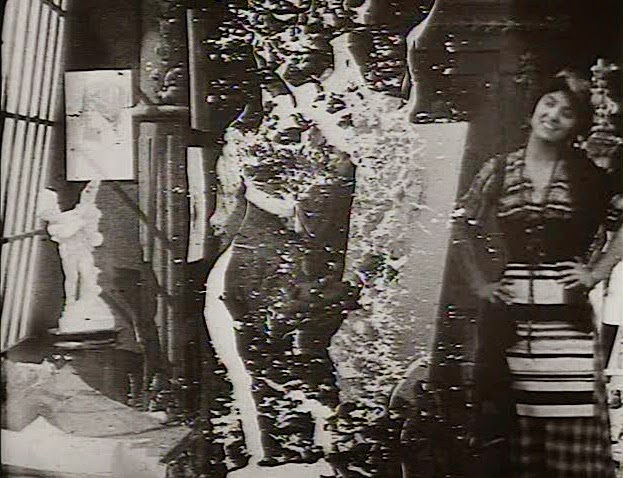
I was watching FW Murnau’s Nosferatu in a cinema a few years ago when something quite unexpected happened. It occured on the first night in Orlok’s castle, just after Hutter has cut himself with the bread knife on the stroke of midnight. Count Orlok extends his arm towards Hutter across the table. All of a sudden, the Count's arm started bubbling and fizzing. It was as if the poison of the vampire’s presence was eating away into the very medium that was depicting him. Though I’m sure whoever owned the print would have been horrified at such a sight, I was thoroughly delighted by such an apposite coincidence of print damage and subject matter (possibly because I had made similar experiments myself with 35mm transparencies many years previously). That’s by the by however, the important point is that it raised in my head a large and generally unexplored area of effect in film, whereby degraded and otherwise abused film stock could be used to heighten certain effects within what the film itself showed. You can imagine my happiness then on finding that Bill Morrison had made a film in exactly this area, Decasia, in which he pieced together what would normally be considered as utterly ruined sections of film stock to create a new film in which the interplay of surface damage with the subjects depicted became part of the film’s overall conception.

I’ve mentioned the happy accident of effect in Nosferatu. Decasia is filled with such images. At one point in his film there is a section of what looks like white-robed dancers of some kind, or even the meeting of a witches’ coven – it is extremely difficult to make out exactly, but that's beside the point. What it could be however, is one of the most atmospheric and mysterious representations of the meeting of the three weird sisters out of Macbeth that I have ever seen, with their ghostly, misty forms being more air than solid matter. These ghostly forms occur frequently throughout the film. Often the film is slowed down to the level of individual frames and so becomes a collection of phantoms, spectres, and ghoulish distorted presences. There is more to unnerve here than in many more traditional representations of ghost stories on screen.

Death imbues its presence throughout the screen. At one point we see standing nuns depicted in negative. This reversal is shocking and, with the line of children they are shepherding pictured advancing towards them, turns them into angels of death counting departed souls instead of anything particularly beneficent. Later, riders on a big wheel at a fairground are subject to a similar sinister operation as an enveloping blackness clouds across the image. The accompanying horn blasts on the soundtrack make it seem as if some deity or other is dispensing random, indifferent fates to the riders – this one, this one, not this one.

This darkness covers the sea too. We see footage shot from the mast of a ship, the film recalling Der Magische Gürtel, the First World War record of a U-Boat’s matter of fact destruction of merchant shipping. That film is shocking because the sinking of ships and goods is so plainly shown. Here, with bow of the ship shown in negative beneath swathes and swatches of damage, it appears as if it could be one of the very merchant ships destroyed, and heading towards its destiny.

This interplay between surface and image throughout maintains constant interest. After the whirling dervish at the commencement of the film (which sets up one of the film’s recurrent visual themes of spinning, turning and spooling) there is then a puff of cloud like an effect in an early Ali Baba film, after which the clouds gradually roll back to reveal the delights on offer. Later, in a shot of waves breaking on rocks, the surface of the film itself bubbles and cockles in liquid ferment. In the final section, as parachutists are pictured falling through the air – which is at the same time an exercise in falling through the uncooperative texture of decaying nitrate film, the film moves into a tracking shot as a black sun glints through the trees on the horizon. he parachutists have established a wartime theme, and suddenly the film itself erupts in shapes reminiscent of WW1 bomb blasts, followed by their spray of dirt.

There’s humour here too though, as with the boxer battling with the damage itself (and landing a knockout blow that causes the film to erupt into another scene); the painter in his studio where the damage of the print can stand for either the white heat of creative composition or the fact that he is so perturbed by his model that he is in a stew; and the miners knocking to see if they can hear life below, with the print damage resembling the noise waves that give them hope.

Tthere are some exquisitely lovely images too, such as the shot of people and camels travelling across the horizon, in a scene that calls to mind something similar in Werner Herzog’s The Enigma of Kaspar Hauser. The nitrate damage also has its own beauty regardless of interplay with the images it obscures. At times it is like watching a monochrome Stan Brakhage or Norman McLaren film.

In fact, one becomes a connoisseur of damage and patterning watching Decasia, watching the different effects, the filigree and the fronds, the coral and speckle and blotch and smudge, the solarisation and flare, the snakeskin patterning and staining, the wrinkles and buckles, the scratches and the scumbles, tears, blisters and puckers, the bubbling, the bloating and the crimping.

At the end of the film, the dervish is still turning, as if he is spinning his own decay, or even trying to prevent it as long as he keeps moving.

The Third Part of the Night (Andrzej Zulawski, 1971)


(written as a review for MovieMail in 2007 and also used as part of a MovieMail podcast in 2008)
_________________________

A disorienting, disjointed fever dream in which colours convey as much of a route to truth as words, this charged, supernatural film of the Resistance and lice-feeding in wartime Poland has an unruly energy that frequently erupts into spasms of violence, but just as often produces scenes of eerie, surreal beauty. Bookended by readings from the Book of Revelation, it portrays a country during a time of doom-laden darkness.

In a country retreat, Michal witnesses the brutal slaughter of his wife Helena and child Lukasz at the hands of armed horsemen, though his wife seems to expect her death and even dresses for the occasion. After laying their bodies out with his father, who intones a Black Mass, (‘Oh God, who does not lead us … oh God, who allows the fragile to be killed and who elevates blind hatred … oh God, who allows cruelty to be propagated and people to torment each other … oh God, who elevates the most evil ones and puts the whip in their hands … oh merciless God, have no mercy upon us.’), he escapes to the city, takes refuge for his life in an apartment, and there aids a birth by a woman, Marta, who seems to be an incarnation of his wife. He spends the remainder of the film unwittingly chasing after his own death, surrounded by symbols that he only dimly grasps. And if this sounds portentous, it is offset by a memorably lurid stylisation more asociated with Hammer horror, by the punctuation of occasional fuzz guitar in the soundtrack and some thrilling, involving, hand-held camerawork around and through the back streets, alleyways and institutes of Krakow.

This freedom of mobility in the camerawork (by Witold Sobocinski) gives the film a visceral, emotional impact well suited to the strange reality of the film’s subject. Zulawski talks of feeling liberated from any academic tradition of cinema when making the film, and away from the dead hand of party interference, he, along with his cast and crew, also felt freed from producing anything ponderous or mannered – though given the story, based on a script by Zulawski’s father about his experiences in wartime Nazi-occupied Poland, this would have been unlikely anyway.

It takes as its central situation, and metaphor, that of lice-feeding. (Says Zulawski of this, ‘The second world war seen through a microscope about lice sucking blood from very naive young people seems to me, up to today, as interesting at least as the battle of Berlin, planes, tanks…’) Curiously, for this is certainly the strangely unsettling part of the film, it was a situation based on fact. During the war, Polish intellectuals found shelter of a kind with the Rudolf Weigl Institute, which manufactured typhus vaccine for the German armed forces. As is depicted in the film, lice cages were attached to people’s legs to fed on their blood. They were then injected with typhus germs which bred in the lice’s intestines, and these intestines were then processed to obtain the vaccine. Those people working at the Institute and infected with typhoid were shunned as untouchables by the Germans and provided with papers that were good against deportation, arrest and hunger. As an apparition of Marta explains to Michal while he is feeding, ‘lice are important as they keep you alive’. As lice-feeding only occupied an hour or so of the day (though the itching lasted much longer), it thus became a convenient core of resistance activities, with which, in the film, Michal becomes involved.

These experiences of a bureacracy dedicated to the nurture and use of lice are expertly and consistently realised on screen, from the shots of the equipment used and the microscopically detailed close-ups of procedures with the lice, to the feeders’ feverish and reddened eye-rims standing out against the background of dingy mustard-yellow walls in the Institute. Despite their being based in fact, it is the matter-of-fact acceptance from all the participants of the oddness of the situation that makes these scenes seem so surreal.

Of course, the skein of the film’s story is also at times twisted and tightened into something far more maniacal. At one point in the film, a lice-feeder says that he will feed well today because he is feverish; ‘Feverish blood has bubbles and it fizzes like champagne,’ he says. The film itself is somewhat like that; its images get under your skin like the fever from a biting louse, and begin to work on your imagination. It’s not a film you can forget.

I said earlier that colour held as much of a clue to the film as words. Against the film’s consistently blue-grey pallor – the blue of oily smoke from cars, of ash and wet pavements, railings and rain and reinforced glass, there is the purity of Lukasz's cornflower blue outfit, an unsullied purity of colour that amounts to something like moral justification and encouragement.

The lice that keep Michal alive, for a while anyway, in the film, are representative of the lice that kept Zulawski’s father alive during the war. When Zulawski says, ‘the blood of contaminated lice flows in my veins,’ he is only partly joking.

Dust Drifts Through Sunlight: Into Great Silence (Philip Gröning, 2005)


(the poem Dust Drifts Through Sunlight appeared in Artesian 3: Time (2011), while the text was written as part of a podcast for MovieMail in 2007)
_________________________

dust drifts through sunlight
like snowfall, the cell’s bare wood
lit with flame, orange as a crocus

·

a warming chimney ticks its heat
as air draws through the stove,
twigs crackling like snow-melt

·

a bow saw snags in a beech log
ringing out the weight of its warmth
through these mountain walls

·

their grain sung into being by woodland birds
floorboards creak a man’s weight
as chaffinch song tumbles through tea wisps

·

cell windows open at dusk to the grain of the sky
this cowl is stone and book paper
winter mist, a dawn dark stream

·

rain drops imprint themselves in water
as bells scour the corridors and chambers
their green stone a river in flood

·

wetted fingers to a white cloth
leave it transparent to the light
an airy pendulum dried by the breeze

·

around the monastery
stars fall like snow
silently through the sky

·

around the monastery
stars fall like snow
silently through the sky


In 1984, Philip Gröning asked for permission to film life inside La Grande Chartreuse, the mother house of the Carthusian Order in the French Alps. Sixteen years later, he was granted a unique shooting permit. As no visitors or tourists are allowed on the premises, and the last shots from inside the monastery were taken in 1960, (and these were only permitted as long as no monks were depicted) this was a rare opportunity, based on a longstanding and trusted relationship between Gröning and the General Prior, to show the daily rituals and requirements of a cloistered, contemplative life. The Prior’s only restrictions on the film were that no artificial light should be used while filming, there should be no additional film crew, and the film should have no additional music and no commentaries – conditions which corresponded exactly with Gröning’s original concept of the film, and to which he readily assented.

Into Great Silence is almost entirely without speech. Instead, usually overlooked sounds come to the fore – the draw of air through a fire, the crackle of wood, the pendulum of a clock, even the falling of snow. Surprisingly, instead of making this a somnolent film, it heightens your awareness so you are receptive to the smallest noises, and even to the atmosphere of silence. Indeed, when a louder noise such as a bell rings, it has a startling effect. Gröning talks of the monks being in a state of permanent concentration due to their regime, in which every moment is filled with tasks, duties and prayer, and in which they never sleep more than three hours at a time. The heightened awareness that this ordered life brings is one area in which Gröning has achieved his stated aim of going beyond mere depiction of the monastery to create an absolute congruence between content and form, so that in a way, the film actually becomes the experience of the monastery, an experience in which the viewer is thoroughly immersed.

At one point, late on in the film, an elderly blind monk says that, “the past is human. In God there is no past; solely the present remains.” This partly communicates the experience of watching the film, in that it takes place permanently in the present. Curiously, this effect is enhanced by the repetitions of actions we see and hear throughout. Sometimes, Gröning varies the form, as when sounds heard earlier in the film are repeated with different, allied images. This is done with a light touch, as when we hear the sound of a washed metal bowl settling to drain allied to a shot of water drips.

There is nothing in the film that is unrelated to its overall conception. Even relaxed or apparently picturesque moments serve a purpose. Throughout we see sunlight illuminating the wooden surfaces of the monks’ cells, the floors and the stone walls of the cloisters, on the monks’ faces, and on fruit. The images are pleasing in a conventional sense but they also serve to illustrate a lesson that we learn about some way through the film, when a monk talks of equating the holy spirit with the sunbeam, and that as the sun shines on all equally but brings light and happiness to individuals, so the spirit gives to each one as if it were in possession of that person alone. From that moment the sunlight that floods the desks and benches, floors and walls, making the wood glow orange, takes on a symbolic hue and turns the film itself into a lesson. More literal lessons are written on the screen and repeated throughout the film, reflecting the recurrent psalms that inform a monk’s life, and in which insight is gained through repetition.

As a moment of relaxation and a change of palette, Gröning inserts a rural interlude in which our eyes are refreshed by the green of spring fields. This is a visual equivalent to the lesson that we have heard earlier in which the Order recommends a walk in the country once a week as a refreshment from the rigorously austere routines of the monastery. It is a nice touch that it is on one of these walks that we hear the monks discussing the importance of living symbolically.

We follow the monks’ lives through the seasons as they live, pray, work, and in one sequence that is surprising (but given the blind monk’s talk of happiness, really shouldn’t be), play in the snow. As Gröning says in his notes on the film, this is a demanding lifestyle with continual claims on your time – a lifestyle in which he partook whilst filming, as he lived in a cell and joined in with the daily routines, formed by necessity and prayer. It is no coincidence that a sound we hear repeatedly throughout the film is that of air drawing through the fire in a burner, which is an object of central importance in each monk’s cell. If the fire goes out, it gets cold (the monastery itself is 1300 metres up in the Charteuse mountains), so you keep the fire in. It allows you to pray.

Of the many images I can call to mind from the film, there are two which keep coming back to me, both of which are related to temporality, impermanence and an eternal present and which can remain as visual lessons in contemplation to return to time and again. Like any good lessons too they are profoundly simple. The first is motes of dust in the air, illuminated in a ray of sunlight. The second was filmed through the course of one clear night, in which time-lapse photography makes the stars of the universe fall like snow, silently across the sky above the monastery.